Though hypothesized to have arrived via a human who had entered an infected cave in Europe prior to visiting one in New York, it is equally plausible that WNS arrived via a bat that hitchhiked in a shipping container. Such transoceanic transport of bats is well documented (Constantine 2003). There is also no evidence that caver decontamination protocols have slowed the spread, though I’d prefer not to see potentially contaminated caving gear transported into WNS-free areas.
Managers and biologists understandably have felt an urgent need to stop WNS or find a cure. Nevertheless, it’s time to admit that we are powerless to stop it and that a safe, effective, and practically applicable cure is exceedingly unlikely to be found. There is no reason to believe that WNS will not spread to all of America’s susceptible, cave-hibernating species, though several have proven resistant.
Available evidence suggests that European bats are hibernating in cooler caves (2-3° C) where the fungus Pseudogymnoascus destructans grows slower and bats metabolize energy reserves at reduced rates. Prior to this fungus arrival in America, most of the continent’s formerly ideal hibernation caves had been lost to bat use due to a variety of human uses. They were forced to survive in marginal conditions that increased costs while speeding growth rates of the fungus, the combination proving lethal for many.
Remnant little brown myotis (Myotis lucifugus) and several other species that were hardest hit by WNS are now reported to be successfully recovering where improved conditions are made available.
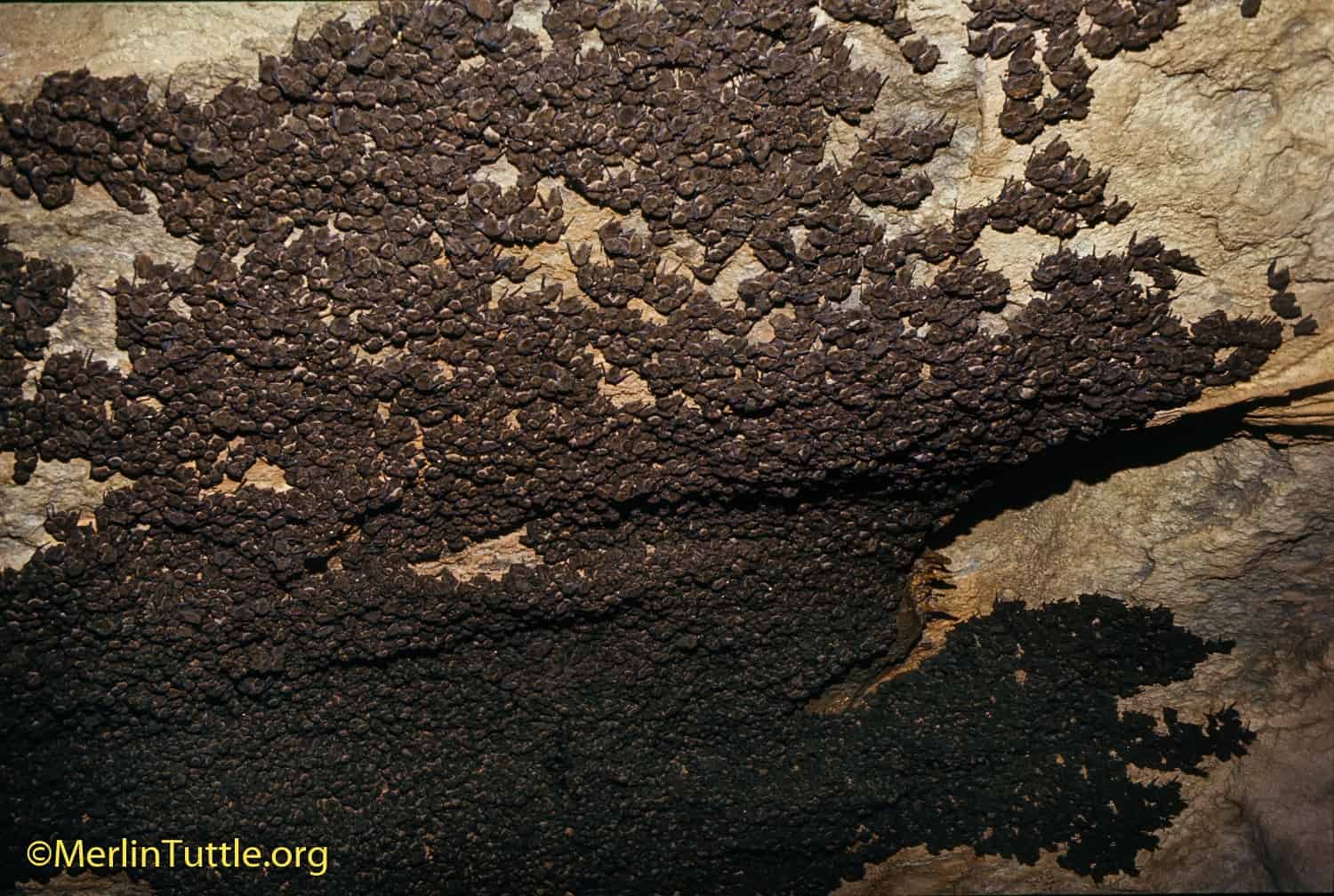
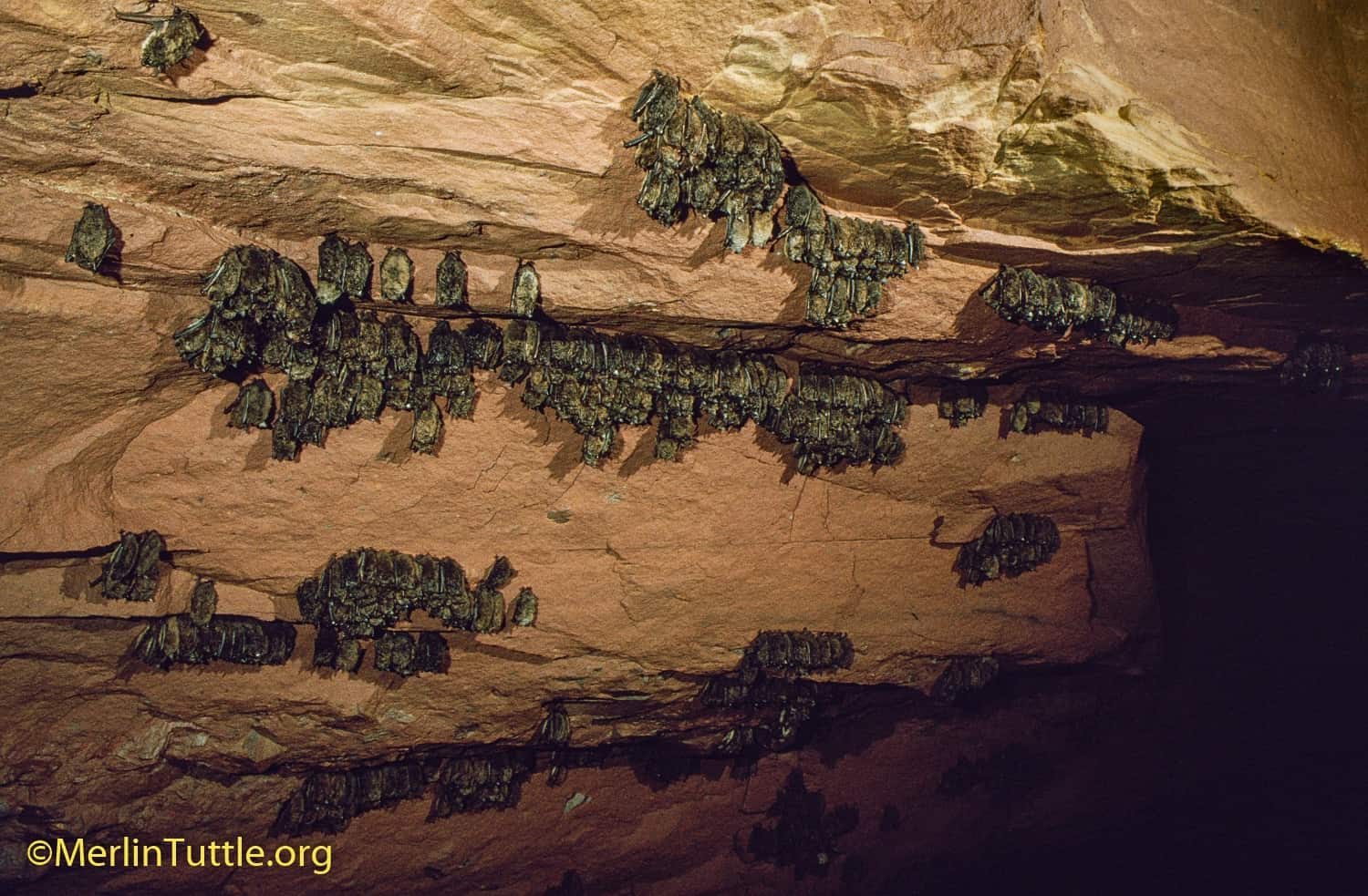
America's largest, most diverse caves often sheltered hundreds of thousands, even millions of bats prior to the arrival of European settlers. However, these were quickly taken over by humans, exploited for nitrates to make gunpowder, as storage sites for perishable foods, and for tourism. These endangered gray myotis (Myotis grisescens) are hibernating in now protected Hubbard's Cave in Tennessee. By 1984 the population was nearly extirpated, but following protection it grew to nearly 500,000. Fortunately, this species is one of several that are resistant to WNS.
Continuing to survey hibernation sites for a fungus that we can’t stop or cure is a waste of limited funds that is likely doing more harm than good. It is time to admit that activities that disturb bats during hibernation are hindering recovery. There can be no justification for adding harm, no matter how well intended the efforts.
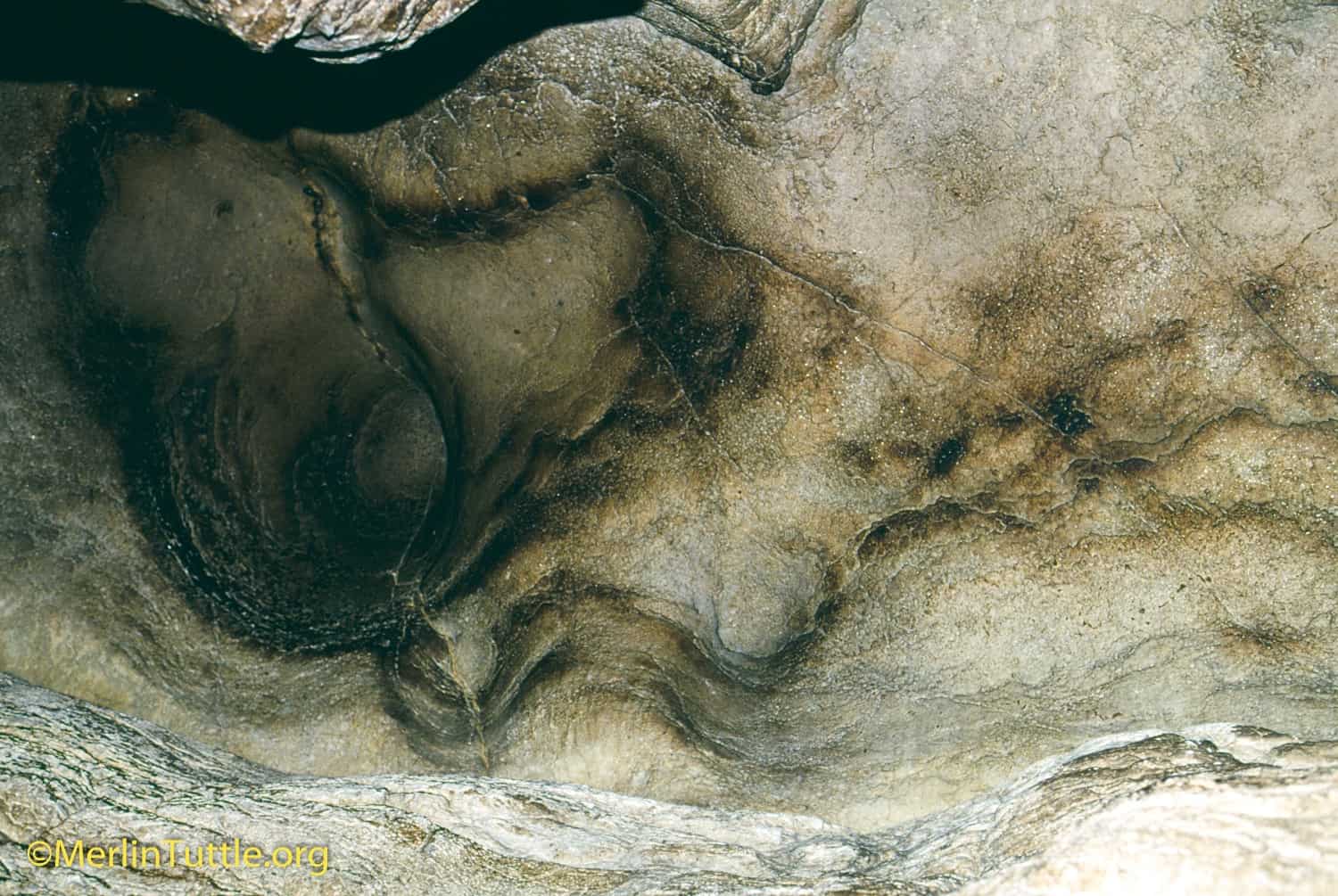
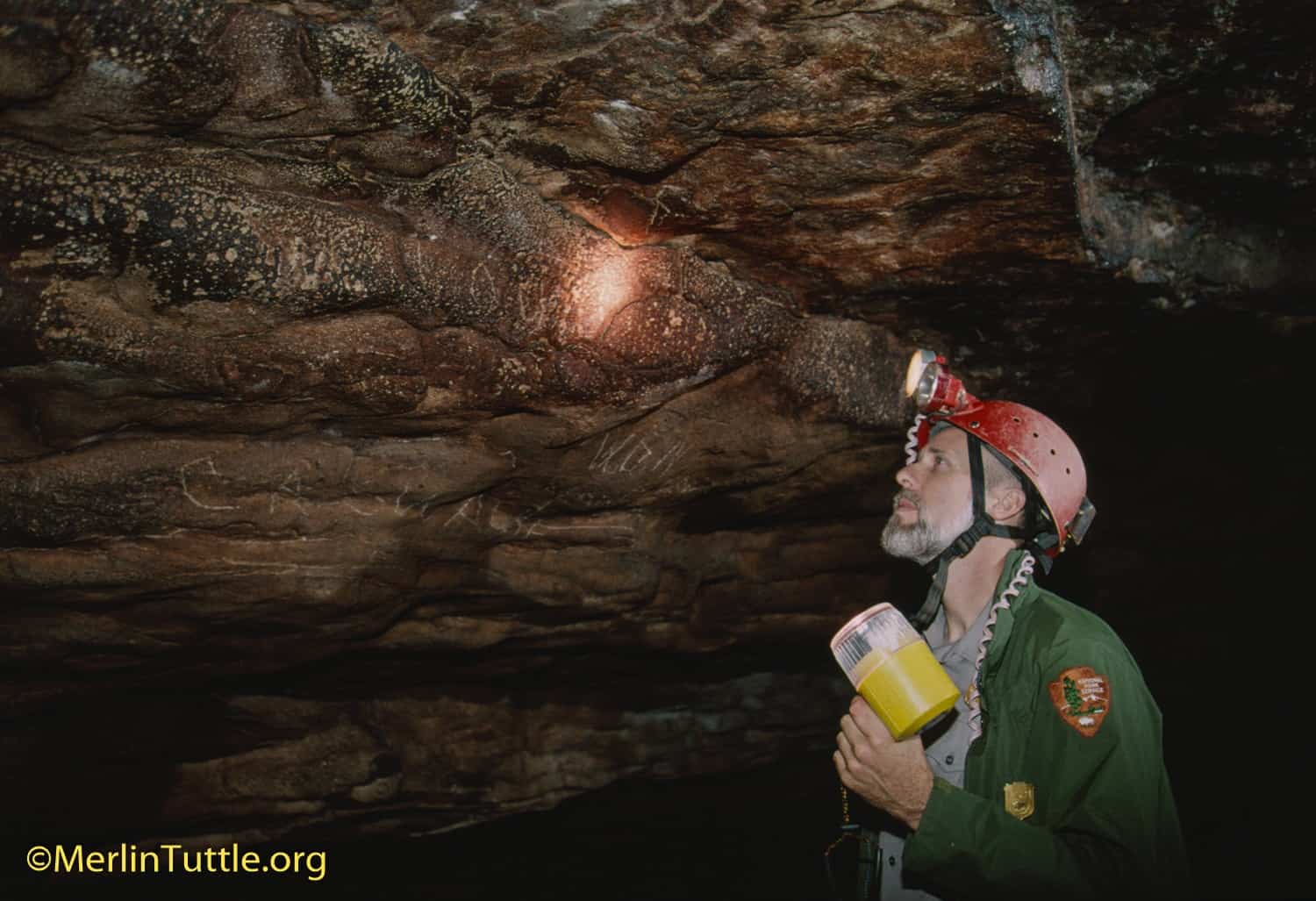
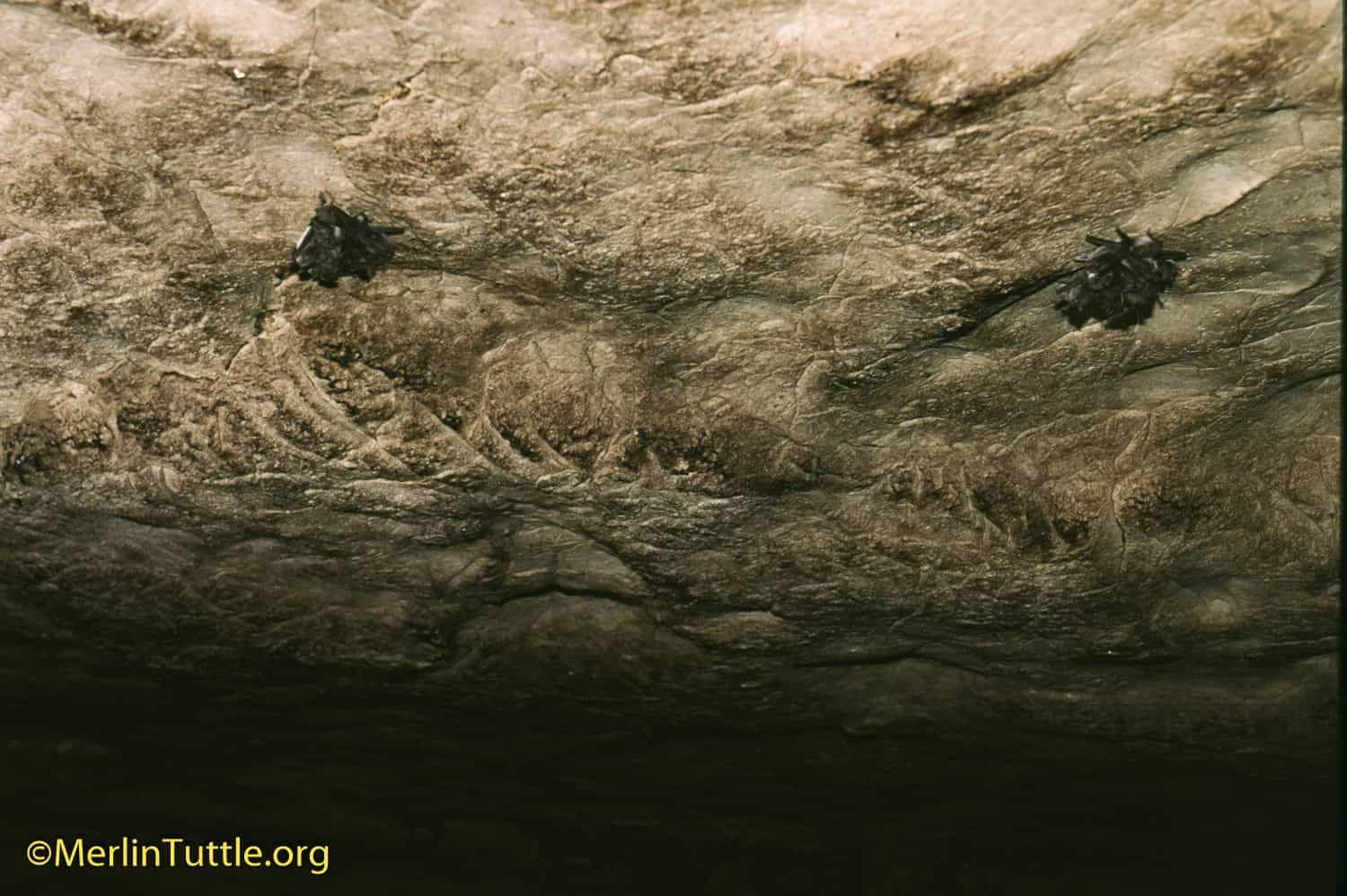
A few remnants of a much larger past population of Indiana myotis (Myotis sodalis). Consistent hibernation use of the vertical wall, but not the horizontal ceiling, of this Kentucky cave has left typical etching and staining that can be recognized for hundreds, perhaps thousands of years, after the bats have gone, providing unmistakable clues as to which caves should be prioritized for restoration and/or protection.
These unmistakable stains left by hibernating endangered Indiana myotis, went unrecognized in Saltpeter Cave, Kentucky for more than 150 years. This population of tens, likely hundreds of thousands, probably was extirpated as nitrates for gunpowder were extracted for the war of 1812. Bats attempting to return in the fall, probably left without even being noticed by the miners who disturbed them. Many took refuge in the nearby Carter Cave, a site that was poorly suited to their long-term survival. Based on their presence, the cave was mistakenly declared as critical habitat. Following recognition of staining and a better temperature profile in the long commercialized Saltpeter Cave, winter tours were halted, and thousands of Indiana myotis began to return, though additional restoration is still needed.
To best help remaining bats the disturbance caused by winter surveys and “cure-hunting” research in hibernacula should be terminated. Major, adversely altered hibernation sites should be restored where possible. Finally, population trends must to be monitored for evaluation of success or failure and for tracking threatened and endangered status. For this, we should focus more attention on expansion and improvement of electronic monitoring in summer foraging habitats and at entrances to key roosts where feasible. If winter entry into hibernacula is permitted at all, it should be limited to no more than briefly at three-year intervals.
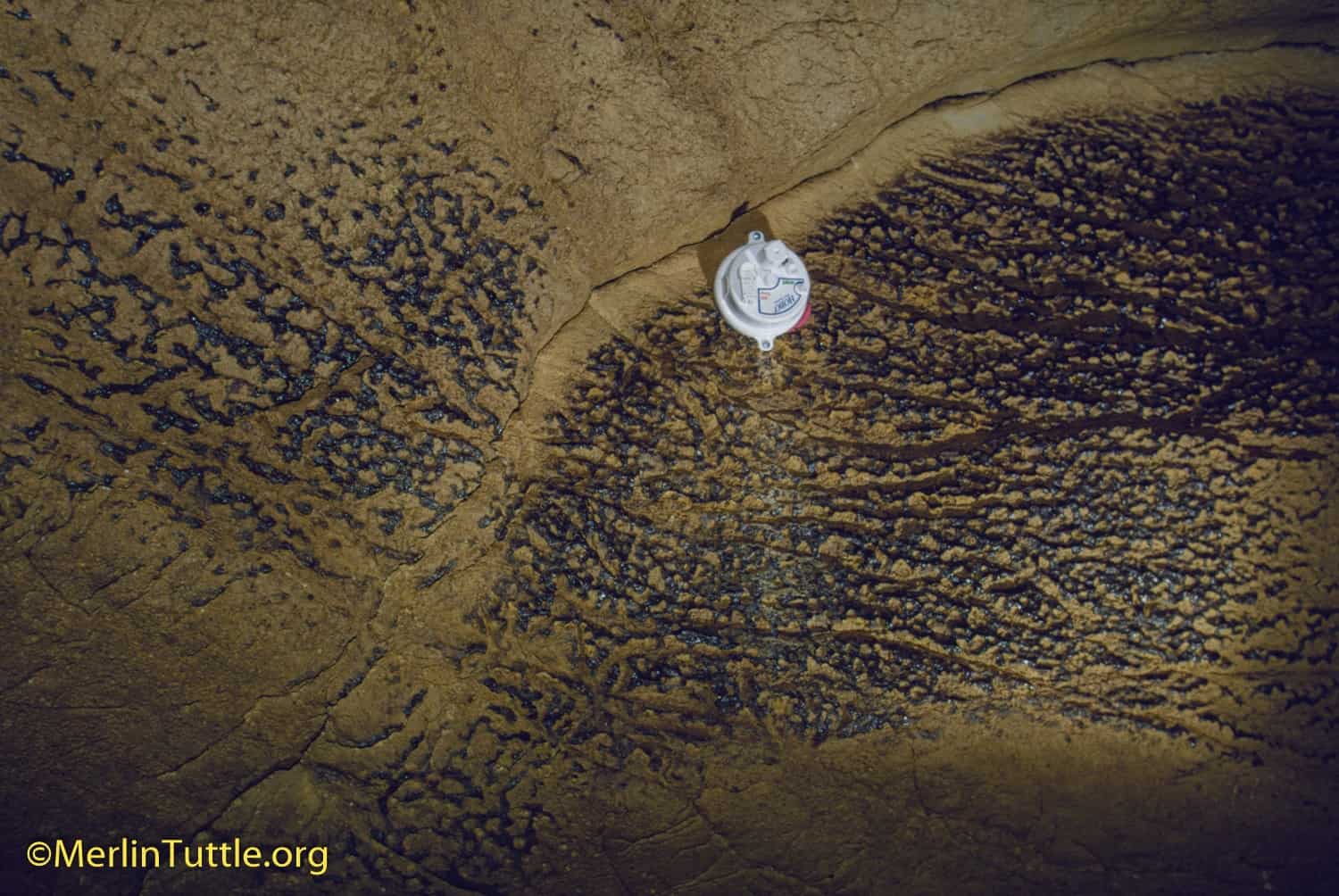
This extraordinarily dark staining and deep etching on a vertical limestone cave wall provided unmistakable evidence of intense, long-term use by hibernating Indiana myotis in a cold Virginia cave The datalogger was placed to record year-round temperature changes to better understand the species' needs.
Mammoth Cave Ecologist, Rick Olson, examining unmistakable roost stains in an area of Mammoth Cave suitable for restoration at minimal cost and without interference with park tours.
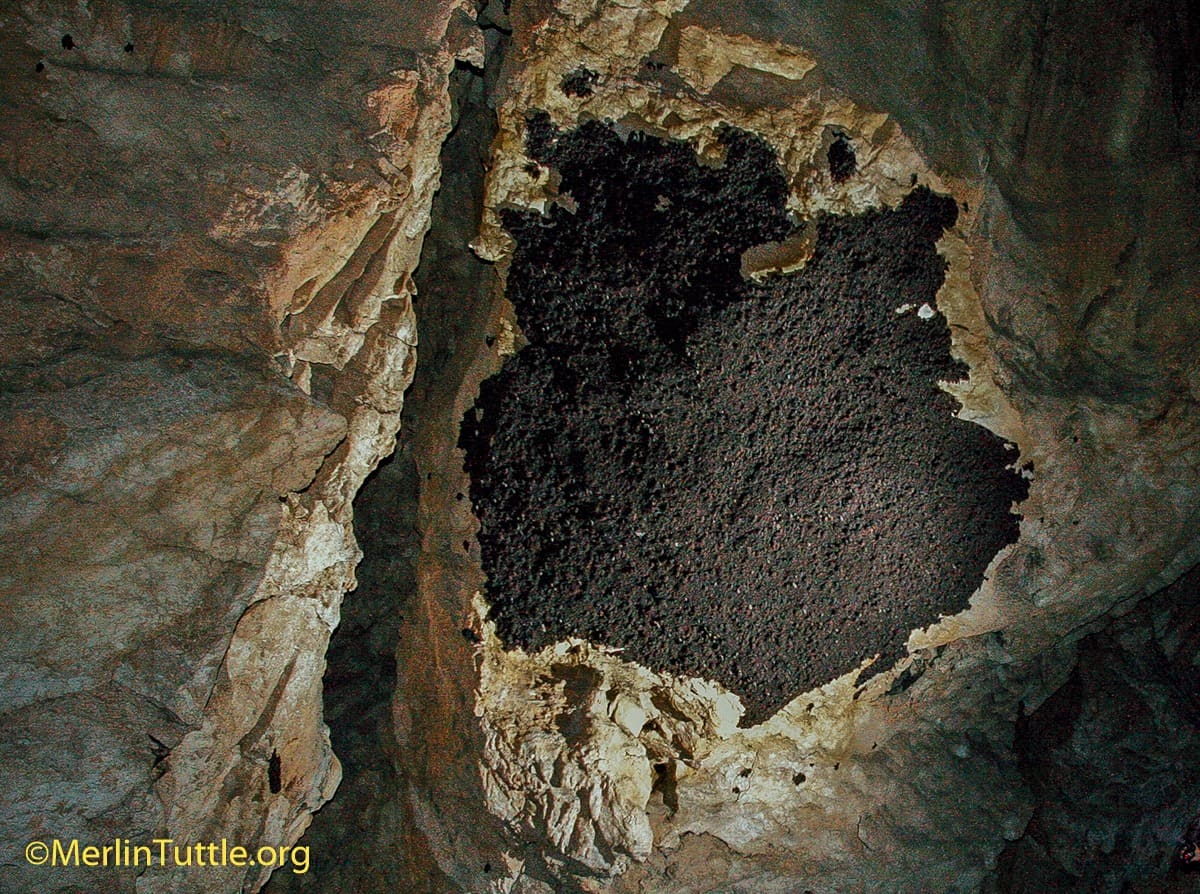
The ceiling of this large room, a part of the Mammoth Cave system, is solidly covered with stains likely left by countless thousands of endangered gray myotis. During our 1997 visit, only a few small clusters remained. However their presence provides hope for outstanding rebuilding potential with proper management.
Many of America’s best traditional bat hibernation caves have been altered for human activities. Some of these formerly sheltered hundreds of thousands, even millions of bats, but most of North America’s bats had been extirpated long before the arrival of WNS. Many former hibernation sites are still unavailable to bats, forcing remnant populations to survive suboptimal conditions (Tuttle and Kennedy 2002) where reported observations can be misleading. In fact, this appears to be a major factor in their susceptibility to WNS. Some caves of key past importance, such as Wyandotte Cave in Indiana, could be better restored at minimal cost (Tuttle 2005). And substantial opportunities exist at key sites, such as Mammoth Cave in Kentucky (Tuttle 1997). Even when former caves of great importance have been protected from further disturbance, altered air flow often hasn’t been restored sufficiently to best meet bat needs.
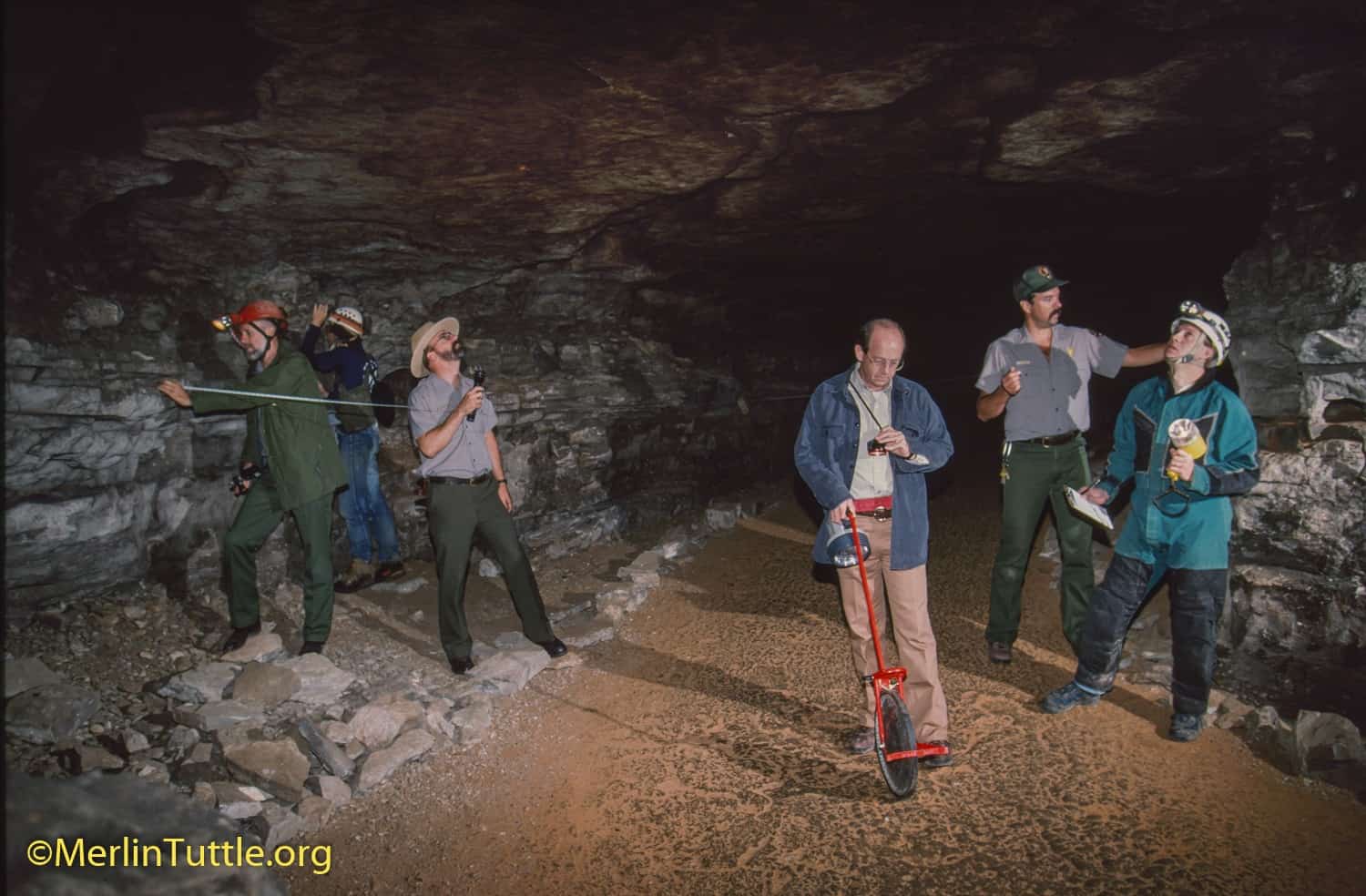
Our team measuring huge areas of unmistakable roost stains in Mammoth Cave, Kentucky. By even the most conservative of estimates, this huge cave formerly sheltered more than 10 million hibernating bats, mostly endangered Indiana and gray myotis, probably including five additional species. The park has made some progress in restoring and protecting this key bat resource, but much more can and should be done. The entire remaining North American population of Indiana myotis is just a tiny fraction of the number that once relied on Mammoth Cave as a key refuge.
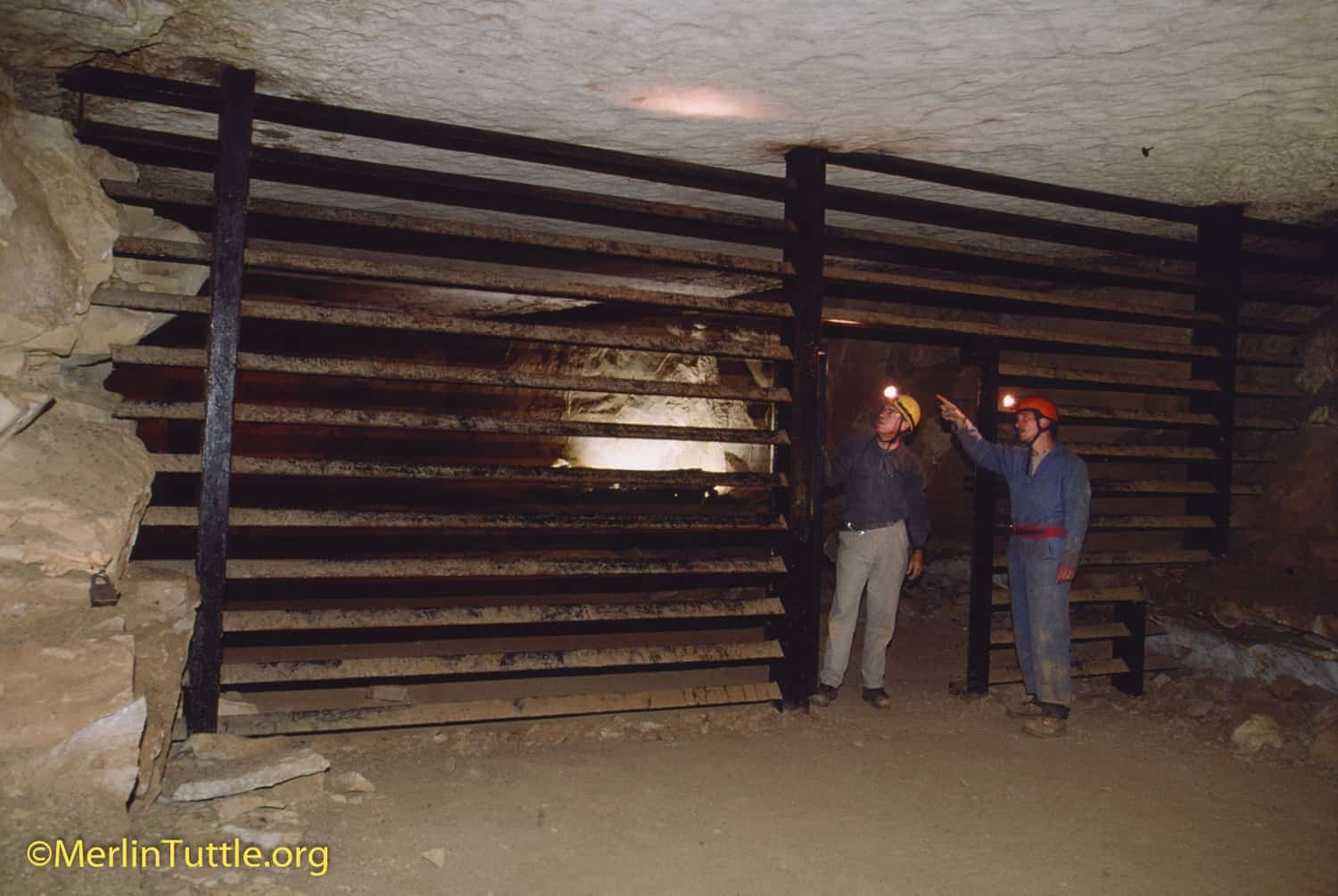
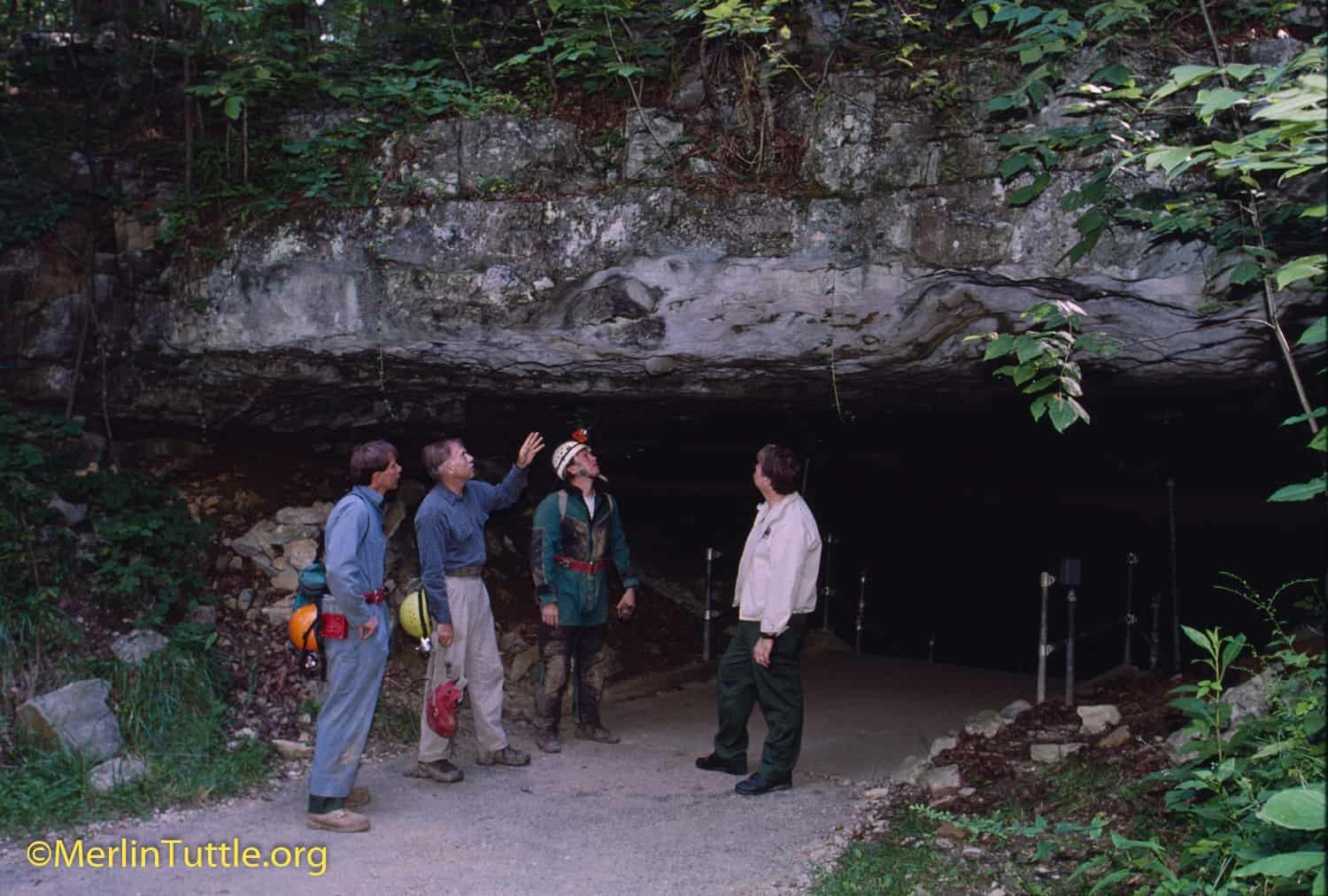
Merlin Tuttle and Indiana State biologist, Scott Johnson discussing the improved gate and further needs at Wyandotte Cave.
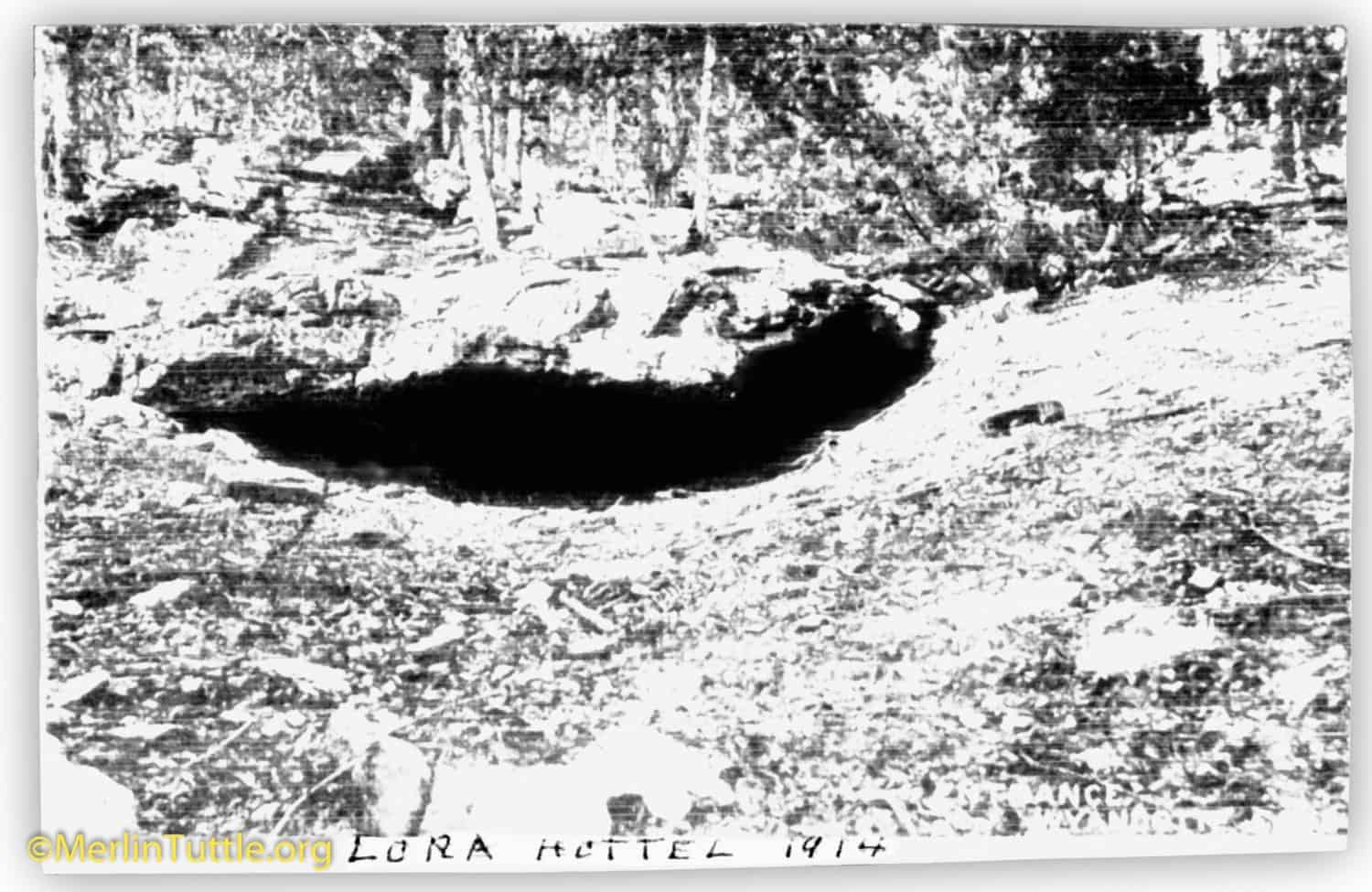
Left: This photo from 1914 illustrates how America’s greatest bat hibernation caves have been altered in a manner devastating to hibernating bats. Wyandotte Cave in Indiana originally sheltered one of America’s largest hibernating bat populations, potentially a million or more, based on roost staining evidence. To enhance access for tourists, its main entrance was greatly enlarged in a manner that permitted previously trapped cold air to escape, like water from a broken dam. For every cubic foot of cold air that escapes, an equal amount of warm air is drawn in through the upper entrances. This adversely raised roost area temperatures. Additionally, a gate that blocked entry of cold air in winter reduced bat numbers to a mere 2,000. A new, bat-friendly gate increased numbers to nearly 27,000 by 2003, at which time I convinced the state to terminate winter tours. In just two years the endangered Indiana myotis population doubled to 54,800, well illustrating the benefit of eliminating human disturbance. It is my firm belief that further provision of an inexpensive several-foot-tall entry wall to once again dam up cold air stored in winter, could result in even more dramatic recovery (Tuttle 2005). For an insignificant cost, Wyandotte Cave could once again become home to more endangered Indiana myotis than now exist in all the rest of America combined. I still dream of this becoming a reality. For this species to have remained endangered for so long is simply unacceptable. Right: During my 1997 visit to Wandotte Cave, I explained how simple it would be to dramatically expand the endangered Indiana bat population by merely providing a low entry wall and door to prevent cold air leakage in summer. This is the same entrance shown above in its unaltered state. Keeping this species endangered is squandering millions of dollars annually, needlessly increasing the cost of nearly every new project in eastern North America and threatening the Endangered Species Act.
In brief, ideal bat caves are those that provide the widest ranges of roost temperature. Most North American bats use caves only for winter hibernation. This is especially true in the northern U.S. and Canada. In the southern U.S. more caves can trap enough warm air to permit use as summer nursery sites (Tuttle and Stevenson 1978).
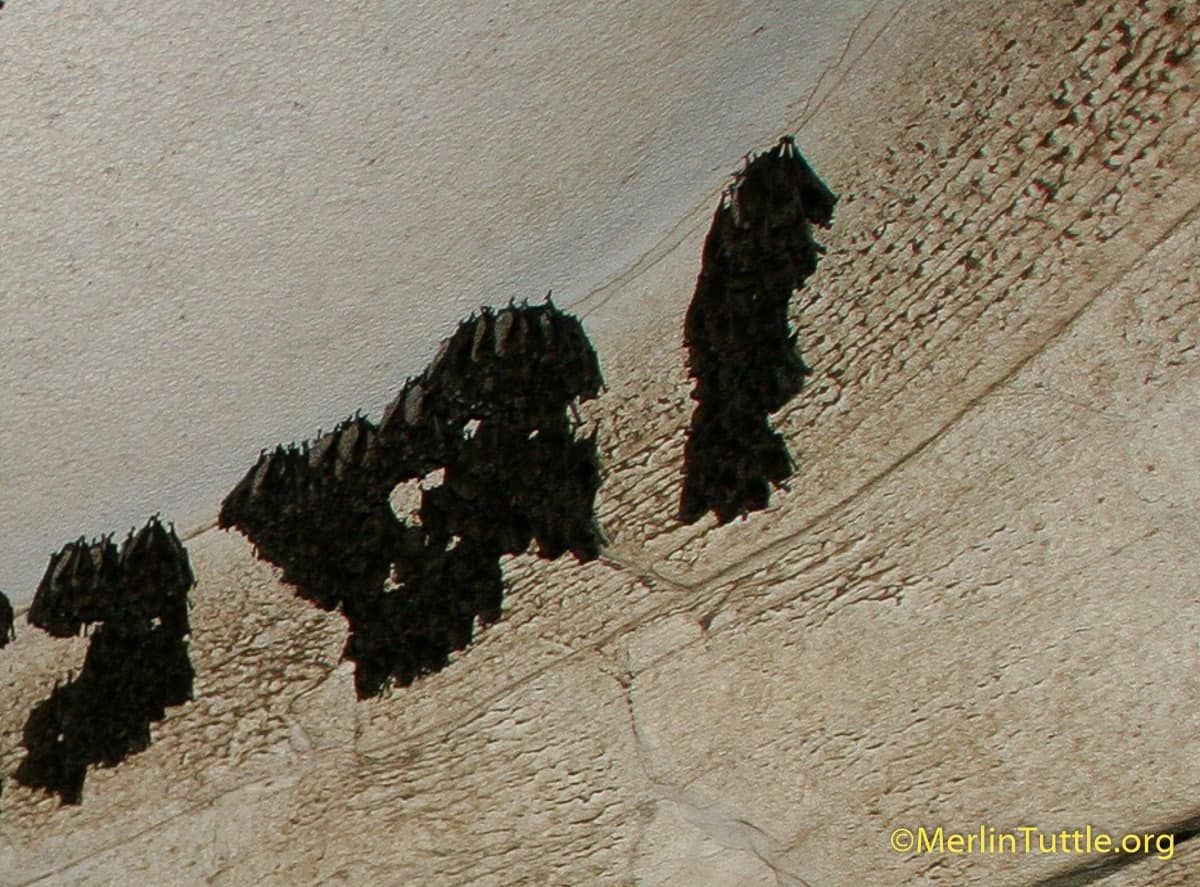
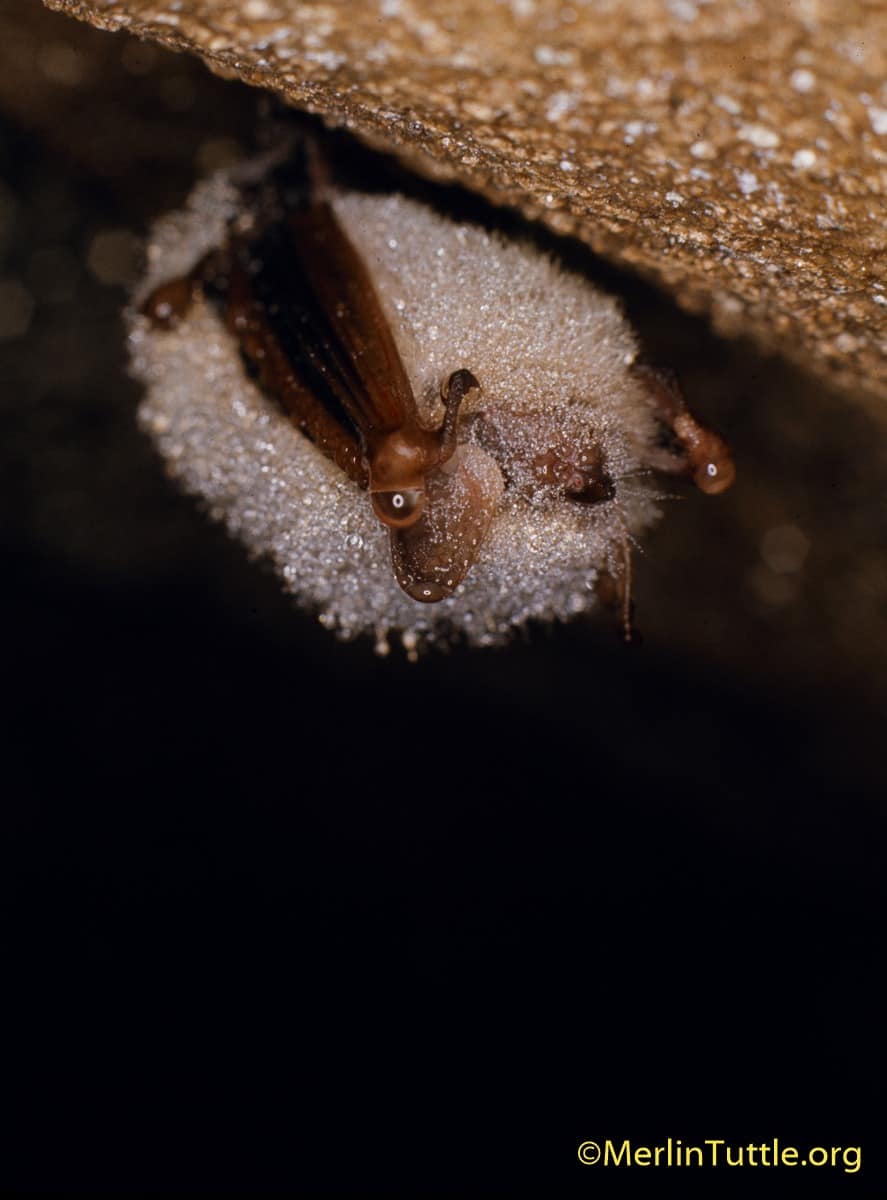
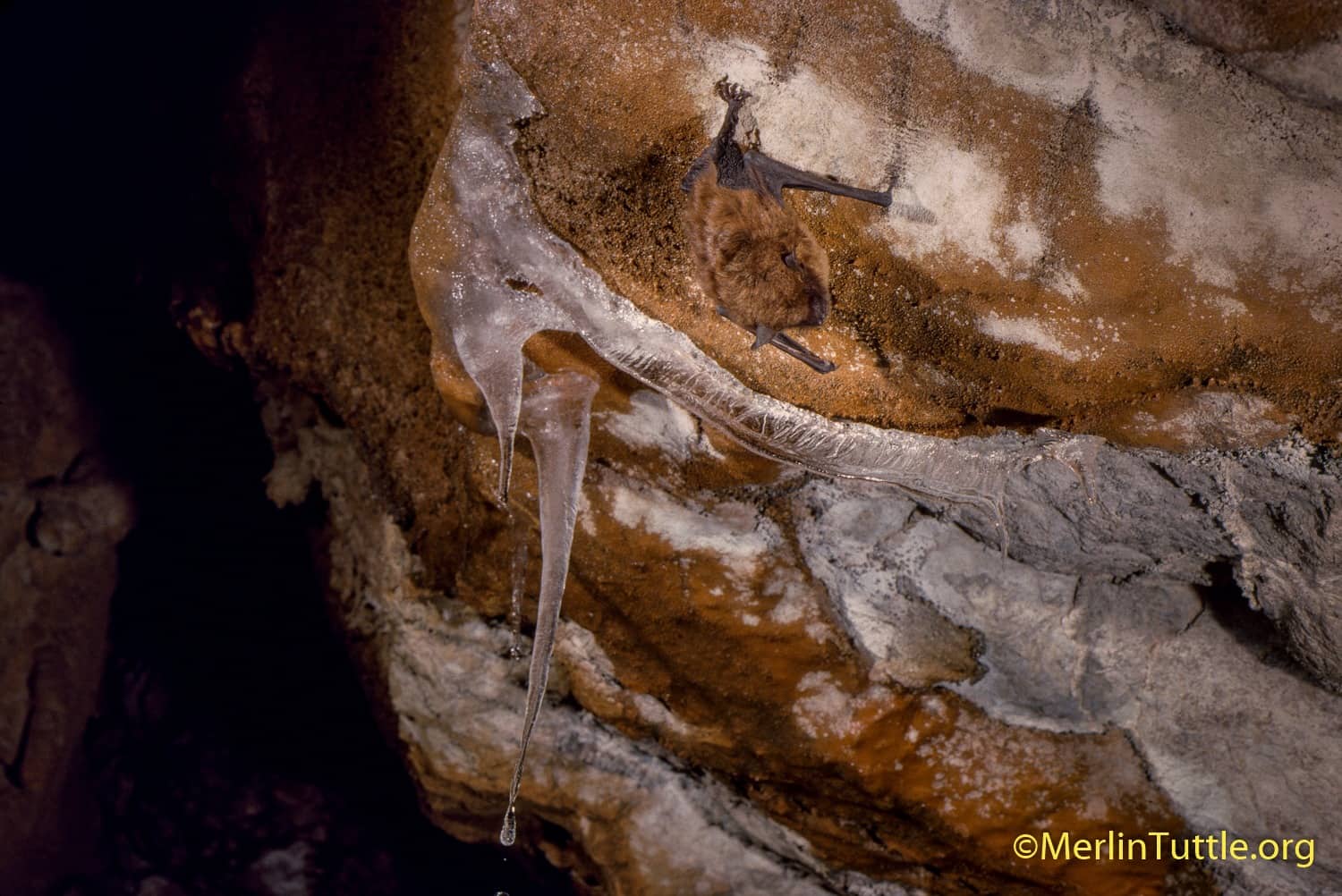
A tri-colored bat (Perimyotis subflavus), also hibernating in a Tennessee cave, has a mostly opposite strategy from big brown bats and small-footed myotis. It cannot survive subfreezing temperatures and is the first to enter hibernation and the last to leave, thus avoiding risk of severe weather. This one is covered in moisture condensation. These extra long hibernators, like big brown bats and small-footed myotis, typically roost alone and are reluctant to arouse in response to disturbance. By reducing arousals, they are able to hibernate in warmer caves than any other eastern species, sometimes at 10 - 12 º C. Nevertheless, when cool roosts, safe from freezing, are available, even this species appears to prefer approximately 9 º C.
Approximately 100,000 gray bats hibernating at 0 - 2 º C in Pearson Cave, Tennessee.
A big brown bat (Eptesicus fuscus) is hibernating in a Tennessee cave in subfreezing conditions. This is the largest species using caves of the eastern U.S. It is extraordinarily hardy, able to arrive during early winter blizzards and is often the first to depart in spring. It can conserve energy by hibernating at body temperatures as low as -1.7 º C. They avoid the extreme cost of arousal from such low temperatures by ignoring all but the most extreme disturbances. Surprisingly, the small-footed myotis (Myotis leibii), the smallest cave-hibernator in the East, seems to rely on a similar strategy. I have repeatedly found them hibernating at freezing temperatures near big brown bats in cave entrances.
Hibernation is best served in caves where large passages or rooms are located below the lowest of multiple entrances at different elevations. This permits chimney-effect air flow and trapping of the heavier cold air in areas large enough to buffer against rapid changes. It also provides relatively stable, low temperatures year-round (Tuttle and Stevenson 1978). Finding low temperatures on arrival in fall is extremely important to saving energy that must last till spring.
Knowledge of hibernation requirements for most American bats is woefully inadequate, often misleading. Much of what we think we know is likely wrong, since remaining bats we’ve seen in caves were often no longer able to occupy preferred locations. Many have moved to warmer, less suitable roosts simply to avoid costly arousals caused by human disturbance. When safe from intrusion they move to other areas, often those that provide lower temperatures. Because existing reports are often misleading, I provide a brief overview from my unpublished observations at especially important roosts where I and others have recorded data.
My best studied gray myotis colony remained stable at approximately 100,000 for some 30 years. However, following several years of protection from all human intrusion, they moved from inner roosts where mid-winter temperatures ranged 7 – 9 º C to roosts much nearer the main cave entrance where the temperature was 0 – 2 º C. Numbers then doubled over the next decade, probably due to energy savings from lowered metabolism and fewer arousals. This cave additionally provides a much warmer upper roost where bats can save energy during brief bouts of activity.
Studies of endangered Indiana myotis indicate a preference for arrival temperatures of 9 º C or less and mid-winter temperatures that are quite stable in the 3 – 6 º C range. Based on personal observations at more than 50 hibernation caves, from Wisconsin to Florida, including sites sheltering more than a million bats, I suspect that most prefer diverse caves that provide extraordinarily wide temperature ranges, roughly 0 – 13 º C in mid-winter. This is a key hedge against severe weather and climate change and also permits large energy saving during, periodic bouts of winter activity. Loss of roosts with such wide ranges of stable temperature, further exacerbated by recent warming trends, may indeed be a contributing factor in WNS mortality.
It is likely that the greatest progress in restoring America’s lost bats will come form greatly expanded restoration and protection of the largest, most complex caves or abandoned mines, especially those that show evidence of past use. Because both bats and humans prefer to use the largest, most complex caves, these efforts can be challenging. Nevertheless, there are still plenty of opportunities for bat conservationists and cave managers to collaborate to their mutual benefit, and reports from the sport caving community can be critical.
Little brown myotis (Myotis lucifugus) hibernating in a Michigan mine. In the far North these bats hibernate for up to 8 months, leaving only 4 to rear young and store fat for the next winter. They and tri-colored bats select the highest humidity roosts of any eastern species in contrast to gray and Indiana myotis who often form tight clusters in dryer areas, a habit that reduces exposure to desiccation. A lab study of little brown myotis demonstrated increased metabolism at temperatures above or below 2 º C, and in a stable Canadian mine these bats predominantly selected 2.1 º C. Also, in an exceptionally stable Missouri mine, Richard Myers found the state's largest aggregation at 1.7 - 4.4 º C. Those that roost at higher temperatures are likely there only to escape disturbance or lack better options. This species normally survives subfreezing temperatures only briefly, but is less vulnerable than tri-colored bats. At similar latitudes the length of their hibernation is intermediate between Indiana myotis and tri-colored bats. Don Thomas found that forced arousals due to human disturbance can cost these bats more than a month's supply of stored fat reserves.
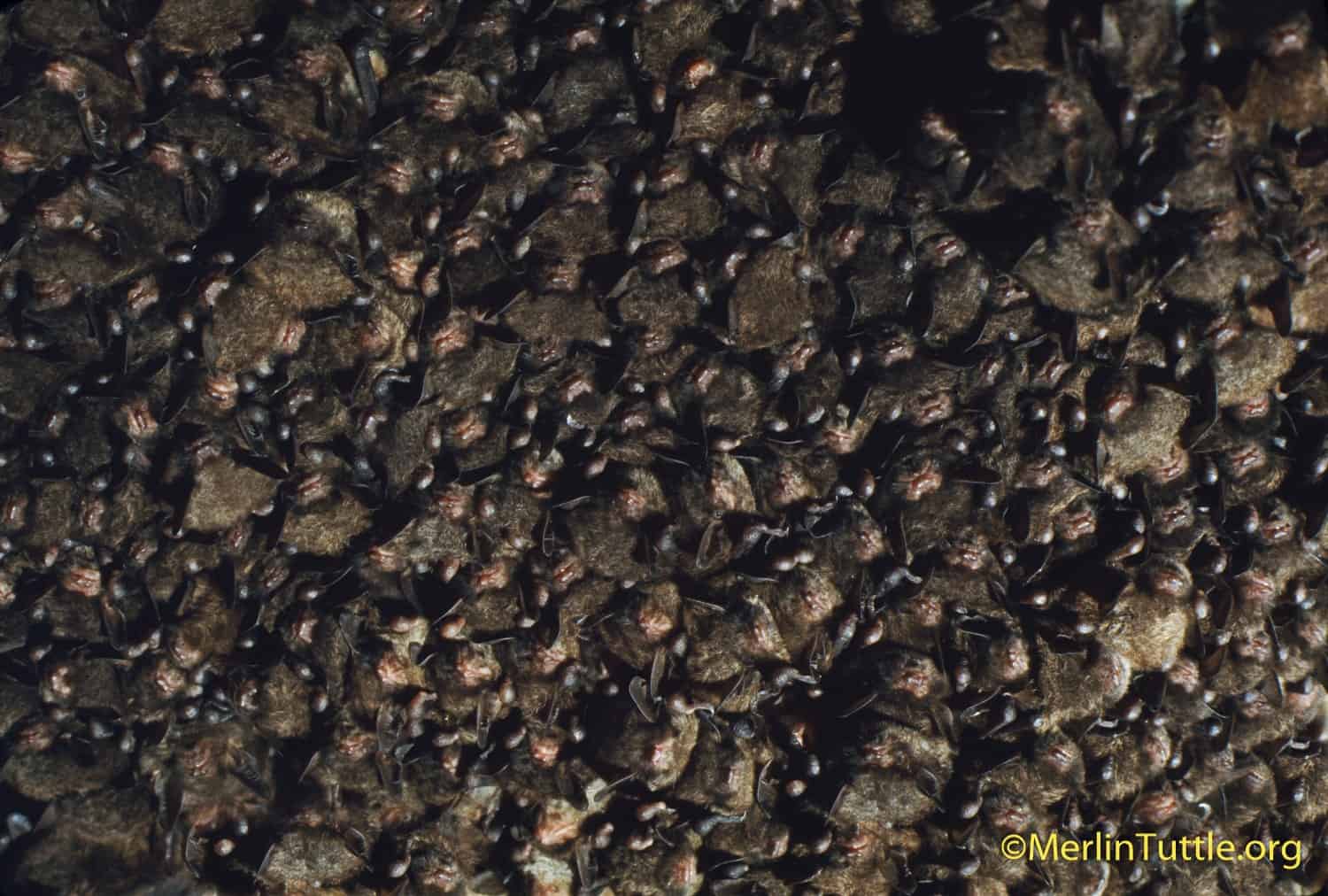
Endangered Indiana myotis hibernating in a Tennessee cave, packed in at over 300 per square foot. Such dense clusters enable them to share the cost of warming during arousals from hibernation, buffer them against freezing in extreme cold, and reduce dehydration. Large aggregations also make them more vulnerable to predators. These bats appear to prefer 3 - 6 º C during mid-winter hibernation. They and gray myotis form the densest clusters at the lowest temperatures. In fact, gray myotis hibernating at stressfully high temperatures form very loose clusters with partially extended wings, exposing increased surface area to cool winter air.
Every summer, more than 100,000 people make their way to Austin’s Congress Avenue Bridge to witness one of the world’s greatest urban wildlife spectacles: more
A Disturbing Scene Beneath the Trees During recent heatwaves across southeastern Australia, heartbreaking scenes unfolded in grey-headed flying-fox (Pteropus poliocephalus) colonies. As temperatures soared past
A 40-year-old prediction of “self-perpetuating bat disease hysteria” has been fulfilled.1 Based on my 65 years of experience, I believe it’s time to revise disease-related
When forests are cleared, not all wildlife responds the same way. Some species adapt. Others struggle. Think of how raccoons and coyotes thrive around towns,
Daniel Hargreaves is a lifelong bat conservationist who has worked globally to facilitate progress, including co-founding Trinibats, a non-profit bat conservation organization in Trinidad. He has organized and led field workshops worldwide, including five for MTBC. Following a long and successful career in business, he now manages a network of bat reserves for the Vincent Wildlife Trust in the UK, supervising research and development of new and innovative conservation techniques. Daniel also is one of the world’s premier bat photographers.
Madelline Mathis
Madelline Mathis has a degree in environmental studies from Rollins College and a passion for wildlife conservation. She is an outstanding nature photographer who has worked extensively with Merlin and other MTBC staff studying and photographing bats in Mozambique, Cuba, Costa Rica, and Texas. Following college graduation, she was employed as an environmental specialist for the Florida Department of Environmental Protection. She subsequently founded the Florida chapter of the International DarkSky Association and currently serves on the board of DarkSky Texas. She also serves on the board of Houston Wilderness and was appointed to the Austin Water Resource Community Planning Task Force.
Michael Lazari Karapetian
Michael Lazari Karapetian has over twenty years of investment management experience. He has a degree in business management, is a certified NBA agent, and gained early experience as a money manager for the Bank of America where he established model portfolios for high-net-worth clients. In 2003 he founded Lazari Capital Management, Inc. and Lazari Asset Management, Inc. He is President and CIO of both and manages over a half a billion in assets. In his personal time he champions philanthropic causes. He serves on the board of Moravian College and has a strong affinity for wildlife, both funding and volunteering on behalf of endangered species.